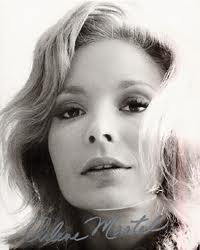
RIP Arlene Martel

AMOvershadowed by the sad loss of Robin Williams and Lauren Bacall, 1960s starlet Arlene Martel also passed away this week from a heart attack. I had the pleasure to interview Arlene for my book Drive-in Dream Girls. Below is an excerpt from it including some of her quotes. She will be missed.

Arlene Martel was one of the many talented Hollywood actors whose face fans recognize but whose name may elude them. In her case it’s even more so since she started out in Hollywood using her real name of Arline Sax. On the big screen Martel had the female lead in the cult film noir The Glass Cage (1964) and played a biker chick in the popular film Angels From Hell (1968), the follow-up to Hell’s Angels on Wheels (1968). But it was on TV where Martel excelled essaying a variety of roles usually hidden under different hair colors and gobs of make-up or speaking in a foreign dialect in such series as Route 66, The Twilight Zone, The Outer Limits, The Man from U.N.C.L.E., Hogans Heroes, Star Trek, The Monkees and Bewitched. The exotic, shapely beauty played so many varied roles that she was dubbed “the Chameleon” by honchos at Universal Studios. “I think this was a hindrance because no one knew it was the same actress from week to week,” commented Arlene. “In fact, in one week I was on three different shows. And nobody knew it was the same person. I think it is very good to have that versatility when you are established as a star. They say, ‘Look she can do this and do this.’ But if the audience doesn’t know it’s you, it is not to your advantage.”

Her comments on some of her most memorable 1960s TV appearances.

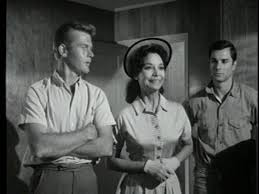
Route 66 “A Legacy for Lucia”

“This was written by Stirling Silliphant so you can imagine the quality of the writing. I played a young Italian girl who meets this American soldier in Italy. Trying to impress her, he tells her that he owns the state of Oregon and if anything happened to him he’d leave it to her. He dies and she comes to America to claim her property. It was a very touching and beautiful experience. We actually shot it in a lumber camp in Oregon. I still feel the air on my face and I still feel the passion that surrounded this character. Both George Maharis and Martin Milner were just lovely to work with.”
AM R66

The Outer Limits “Demon with a Glass Hand”

“When I first read Harlan Ellison’s script I felt inspired by it. I felt I could do a lot in the role of Consuela. This part had a lovely substance that I connected with. Byron Haskin was our director and he was wonderful! He was the reason I got this role. When they replaced me with Christiane Martel [in the 1959 movie The Little Savage], Byron told me, ‘One day I will make it up to you and find something else for you.’ And sure enough he did.”

“I believe Harlan Ellison was on the set during filming but to tell you the truth my concentration was so much on my part that other than Robert Culp I don’t think I was aware of anyone else. I was very focused on what was happening between our characters.  I found Culp to be very attractive in many ways. I got a very beautiful feeling about him. I thought that as a person he projected a lovely sanity. I enjoyed working with him. He remains a favorite.”

“I also had an operation and had just been released from the hospital the day before. If you watch the episode you’ll notice that as I am being pulled by Robert Culp I am running very stiffly with my arm at my side because I was nervous that the stitches would open. I was running in so much pain—up the stairs, down the stairs—but I was afraid to tell them that I just got out of the hospital because I thought that they would replace me. I kept that to myself and just prayed, ‘Oh dear God please don’t let me start bleeding all over the place.’”

AM OL

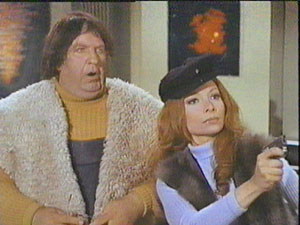
The Monkees “The Spy Who Came in from the Cool”

“The guys were having a ball doing this series. I had an especially good rapport with Peter Tork and Davy Jones. There was a great deal of joviality on the set. I hung out with them one day and it was the first and only instance where I wasn’t on time getting back to a set. The air was thick with smoke and I guess I innocently inhaled. I was twenty minutes late and the director berated me mercilessly in front of the cast and crew.”
AM M

Star Trek “Amok Time”

“[Director Joseph] Pevney kept guiding me towards doing less and less and less [playing a Vulcan betrothed to Spock]. Finally he said, ‘Do even less than what you’re doing.’ I said, ‘But I wouldn’t be doing anything at that point.’ He replied, ‘That’s exactly what I want. It will come through.’ So this very dry, icy, intellectual quality came forth and that is exactly what he was after. But it was very different from everything else I had done.”

“Every time Celia Lovsky pronounced one of the Vulcan words Bill Shatner would whisper something funny about it and get me to laugh, which was terrible to do. It was just terrible of him! Of course Ms. Lovsky wasn’t aware of this. But she had difficulty pronouncing the Vulcan words. Bill was like a naughty schoolboy and suddenly I became five years old too. At one point, the director threatened to throw us both off the set. I have very good concentration but Bill just broke me up.”

“Leonard Nimoy was rather removed. Maybe he was maintaining his character—I don’t know. Or maybe he genuinely didn’t like me! I have no idea to this day. We were cast together in three different shows. Before Star Trek we played a mountain couple in the western The Rebel with Nick Adams and I also worked with him later on Mission: Impossible. I thought I was very good to work with and that I gave a great deal in my work. For some reason, he remained very aloof.”

AM ST


ANOTHER HARROWING MEMOIR FROM A 1960S ACTRESS

sharon-farrell-1If I thought Diane McBain had a harrowing life that she wrote about in Famous Enough, it does not compare to what her 1960s contemporary Sharon Farrell revealed that she went through in her fascinating memoir Sharon Farrell “Hollywood Princess” From Sioux City, Iowa: The “Bad Girl’s” Story. First the simularities: both are pretty blondes who were two of the most promising starlets of the 1960s; both had one son from short-lived marriages; both saw their chances for super stardom fade away; both did drugs; and both were rape victims. But for every horrible incident that befell Diane McBain, Sharon Farrell’s was even worse.

As someone who loves reading (and writing) about the back stories in making movies or TV shows, Sharon does not disappoint with her career highlights such as Marlowe with Bruce Lee; The Reivers with Steve McQueen; The Last Ride of the Dalton Gang with Jack Palance; Out of the Blue with Dennis Hopper; The Stunt Man with Peter O’Toole; and her stint as a regular on Hawaii Five-0 during its last season. However, most are unhappy experiences and depressing to read as she is used and degraded (physically and/or psychologically) by practically every leading man and then tossed away once filming stops. She gets credit for not holding back and depicting herself in a very unflattering manner, but as you keep turning the pages you just hope she finds happiness. Instead the drug taking and sexual abuse by many hideous men continues and also because she foolishly binds herself to a man who took so much advantage of her stealing her money and forcing her to relocate to Fiji. Finally free of him and back in the States, Sharon finds herself committed to a psycho ward in California, which is really hard to read considering what she was put through.

What is most amazing to me despite the living hell she was going through in the 1970s and 1980s, is that she worked pretty consistently and got some really good parts well into her forties doing better than her more stable 1960s contemporaries for sure. This was due to her acting talent and her professionalism on the set despite what was happening to her off-camera.

Though Sharon highlights her major films/TV shows, her body of work is tremendous and I would have liked to have read more about them and less of the sex/drug tales she shares. Being self-published, the book is at times a bit disjointed and contains misspelling and such. Even so, I still recommend the book to fans of Sixties actresses and the New Hollywood of the late 1960s (let’s hope actresses in the Golden Age of Hollywood weren’t treated this shabbily). The fact that Sharon Farrell survived all she did and is still alive to tell about it is a testament to her strength and courage. Kudos to Sharon for persevering.

[amazon_enhanced asin=”1477511113″ /][amazon_enhanced asin=”1593935765″ /]

MOLLS OF BATMAN: EILEEN O’NEILL as MILLIE SECOND

When I began interviewing 1960s starlets in the late nineties I always asked them about working on TV’s Batman, if they had on their list of credits. It was one of my favorite TV shows as a kid. Though the villains stole the show, I always took a special liking to the dastardly dames by their sides. Some of the most beautiful starlets of the day donned miniskirts to catsuits to fabulous furs to help their man defeat the Caped Crusader. Some repented for their greedy ways while others went down swinging. My next couple of Blogs will pay tribute to some of them in honor of the upcoming DVD/Blu-Ray release FINALLY of Batman this Fall.

First up sultry brunette Eileen O’Neill as the Clock King’s cleverly named moll Millie Second who was one of Batman’s most eager crooked gals who seemed to just revel in her boss’ sinister schemes. Awed by his cleverness, she even calls him Your Highness, but her character, who had a lot of potential, is wasted and not given much to do.

eon

In “The Clock King’s Crazy Crimes” and “The Clock King Gets Crowned,” which originally aired on October 12 & 13, 1966, viewers are introduced to Gotham City’s newest multi-wrist watch wearing villain as he and his moll Millie Second watch the goings-on at a high-end jewelry store through a hidden camera planted in an antique clock. The Clock King then releases knockout gas as his thugs nicknamed the Second Hands race in and make off with diamond bracelets and necklaces. When Millie Second, clad in a mod striped green and blue mini-dress and always holding a feather duster, gets a peak at all the jewels she coos, “Just look at all these goodies! They’re marvelous Clock King.” Unfortunately, Millie Second is AWOL for the rest of the episode (guess someone had to stay behind and dust all those clocks).  She doesn’t even show up after Clock King captures the Dynamic Duo and puts them in a giant hourglass complete with the sands of time pouring in on them.

With time ticking away, Batman and Robin are able to knock over the hour glass and then like squirrels in a cage roll it out onto the street where they are freed. Unaware that his arch enemies are alive, Clock King boasts of their death at his hands as an enamored Millie and his Second Hands clap in approval. The egotistical thief then makes his final plans to crash Wayne manor to steal the millionaire’s collection of antique pocket watches. “This sure is tingly,” exclaims an excited Millie as they view the goings-on at the mansion through a clock Aunt Harriet bought as a birthday gift for Bruce. Frustratingly, Millie stays behind again to do her housework as the men folk go on their crime spree. She finally does go along for the big score when The Clock King plans to gas the entire city while he hijacks an incoming helicopter transporting a cesium clock. This was the time Millie should have stayed back as the Dynamic Duo ruin his plans. The only time left for Clock King, Millie Second, and the Second Hands is the time they are going to serve in the Big House.

Given more screen time, Millie Second could have been one of the series’ most memorable molls instead of just pretty decoration. Eileen O’Neill definitely had the acting talent to do more as shown by her numerous TV and movie appearances during the sixties. To read more about her, catch my book Fantasy Femmes of Sixties Cinemanow available in revised soft cover edition. Below are Eileen O’Neill’s remarks about working on Batman from it:

“Walter Slezak [the Clock King] was another kind man.  We spent so much time talking.  I sensed an effort on his part to share his richness and experience in the theatre with me.  We had extensive conversations on acting.  Again, I appreciated the knowledge you can incur like a sponge when you have an opportunity to talk to people who are so good at what they do.”

“Burt [Ward] and Adam [West] were professional and so much fun to work with.  They both jumped into the zany spirit of their roles.  They played their parts to the hilt and that is why Batman was so successful in its day.”

Next Bat Time, Next Bat Channel: Tisha Sterling as Legs Parker

[amazon_enhanced asin=”0786461012″ /][amazon_enhanced asin=”0786408685″ /]

**** for DIANE MCBAIN MEMOIR

httpv://youtu.be/mQ9A06z-9nE

Just finished reading Famous Enough: A Hollywood Memoir by Diane McBain and Michael Gregg Michaud. It has to be one of the most brutally honest memoirs I have ever read. It is a harrowing tale of what happened to Diane (and probably a lot of other 1960s female contract players) once the studios tossed them out without fanfare during the mid-1960s when the studio system was collasping. Surprisingly, Diane did not make a lot of money while working for Warner Bros. despite starring in a TV show (Surfside 6) and getting leads in motion pictures (Parrish; Claudelle Inglish; The Caretakers; A Distant Trumpet; etc.). Today, actors doing the same are millionaires 3 times over.

Grass is always greener on the other side, so when Diane refuses to play a small role in a Natalie Wood comedy she knew she would get the boot, but thought life as a freelancer would be better. She soon learned the harsh realities of going it alone in mid-sixties Hollywood. Always one of my favorite blondes of all-time (along with Carol Lynley and Yvette Mimieux), I found it mind boggling on why she did not do better. Though I love Diane in the Elvis musical Spinout and her AIP exploitation movies like The Mini-Skirt Mob, she should have still been getting studio A picture offers. Soon Diane would be joined by Sandra Dee and Connie Stevens who when their studios set them free in 1966 or so, they too could not land any more major motion pictures. The times they were a’changin’ and these gals were just not hip to the Free Love crowd.

Diane does not hold back in her book slamming actors she disliked (hear that Edd Byrnes); her sexual exploits (she had an itchin’ for unattainable men); her drug taking; and her brutal rape in the early 1980s. She also must be one of the unluckiest actresses in Hollywood in regards to roles that might have been and the number of times she was a victim of a crime. One of the book’s highlights is her documenting her two trips to Vietnam in 1966 and 1967 to entertain the troops.

Once the book passes 1970, my minor quibble is that though she mentions all the low-budget movies (Savage Season, Deathhead Virgin, etc.) and TV shows she appeared in they get short shrift. I really like hearing the back stories in depth. Instead, Diane concentrates on her life outside of acting as she needed to support herself and a child. While her contemporaries like Carol Lynley, Connie Stevens, Anjanette Comer, Sue Lyon and even Sandra Dee were landing leads in TV movies, Diane for some reason was barely getting supporting parts in episodic TV. For me Diane always had an air of glamour and sophistication. She was the Dina Merrill for the 1960s teenage set though most of her big screen charactes were usually icy and bitchy. Diane Baker had the same effect, but she came off like that even while trying to play the sweet ingenue. If she was able to get steady work through the 1970s, I have no idea why McBain was not as she had the ability to play sweet and not so sweet believably. In the book, Diane attributes her fading movie career to the New Hollywood of the independent filmmaker who shunned glamour for more real looking actors.

Diane McBain’s memoir was an eye opener for me and is truly recommended. And despite her struggles, it does have a well-deserved happy ending for the still gorgeous actress.

[amazon_enhanced asin=”1593935765″ /]