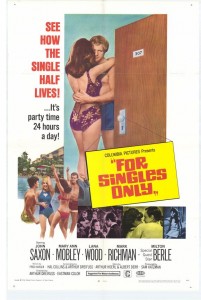
For Singles Only (1968) from Columbia Pictures is one of the many, as I call them, too-square-to-be-hip movies released by the major film studios in the late Sixties trying to capture the Counterculture audience the way American International Pictures were doing. Others I put in this category include C’mon, Let’s Live a Little; The Cool Ones; How Sweet It Is; Hot Rods to Hell; The Maltese Bippy; How to Commit Marriage; and Norwood, among others. Most of these films’ producers/directors/screenwriters were over 45 and had no clue about the younger generation, which is all too evident in the final product. The studios were trying to connect with an audience that wanted more adult entertainment but they could not let go of their Fifties’ morals and sensibilities that were still instilled with the Motion Picture Code. Thus, you got a period of schizophrenic filmmaking with For Singles Only as a prime example.
Sam Katzman, the King of the B’s, produced For Singles Only. He also gave us during the decade Hootenanny Hoot; Get Yourself a College Girl; Kissin’ Cousins (which doomed Elvis Presley to low-budget movies afterwards); and When the Boys Meet the Girls, among others. All were released between 1963 and 1965 and were wholesome pleasant musical comedies. For Singles Only, on the other hand, is a totally out there musical/comedy/drama that features body painting, hippie bands, strip word games, computer dating, and a gang rape. You know the times they were a changin’.
httpv://youtu.be/qq0wxicShDU
Pretty Mary Ann Mobley and Lana Wood star as two friends who move into the Sans Souci Club and Apartments for Singles inSouthern California. Mobley has just returned from a stint in the Peace Corps and Wood is a librarian who wants to shake her staid lifestyle. Milton Berle is the complex’s social director and tenants include hunky John Saxon (who fills a tight pair of chinos oh-so-nicely) as a struggling PhD candidate; Mark Richman as a wealthy older guy with a possessive sexy blonde girlfriend, Chris Noel; Duke Hobbie and Charles Robinson as single dudes out on the make; and Ann Elder as a dippy redhead who thinks every guy in the apartment is after her. Elder introduces the newcomers to the residents, as jazz group the Walter Wanderley Trio with Tayla Ferro plays poolside. This being a Katzman production it is no surprise that an eclectic array of musical talent is presented including the Nitty Gritty Dirt Band, the Lewis and Clark Expedition (in a weird turn clad in pioneer garb and performing the song “Destination Unknown” in an upscale nightclub), and the Cal Tjader Band.
After striking out with Mobley or as she is dubbed “Old Ironsides,” Hobbie and Robinson bet Saxon that he can’t score with her. Wood catches the fancy of Richman to Noel’s chagrin. Elder meanwhile works for a computer dating service and accidentally gets matched with Mort Sahl even though neither meet the other’s criteria in a mate. As expected, Saxon falls for Mobley and purposely loses the bet even though Mobley tries hard to seduce him. Wood learns that Richman is married from a vindictive Noel and deponent winds up in a sleazy beachside pool hall where she is chased to the shore and gang raped. All’s well that ends well, as Wood, looking glamorous and not any worse for the wear, recuperates in the hospital while Mobley and Saxon check out of the complex as newlyweds.
For Singles Only is not an especially good movie as it cannot make up its mind if it is a serious look at the changing sexual mores of the time or a musical comedy poking fun at the new fads. However, it is a pleasant diversion buoyed by an attractive cast that does well in their roles and a catchy title tune performed by The Sunshine Company. The only disappointments are the musical groups which are a comedown from Katzman’s previous movies and Ann Elder who is more annoying than funny. The part needed Suzie Kaye or Gail Gilmore both of whom excelled playing the dippy airhead in previous teenage movies. For Singles Only is a bit daring for its time, but watching it you can’t believe only a few months later Easy Rider, Midnight Cowboy, and Bob & Carol & Ted & Alice were released.
Below are comments from Lana Wood and Chris Noel about making For Singles Only in my book Fantasy Femmes of Sixties Cinema:
Lana Wood: “There’s a funny story pertaining to the rape scene. I had to have a double to do all the rough stuff. This casting company sent out a bunch of girls and they were all lined up. The director asked to them walk up and down. This one girl named Ginger had a very similar build as me and she had my walk down perfectly, but I didn’t realize that I walked like that. I was in stitches because her walk was so funny. I thought, ‘My God, I have a strange walk!’ Chris Noel was just so sweet. I remember being absolutely intimidated by Chris because she was so gorgeous.”
Chris Noel: “I don’t remember too much about this film. It was a very hectic time in my life. John Saxon was a nice guy. He is very handsome and very bright. I liked Lana Wood. I never liked her sister Natalie, but Lana was neat. Natalie was stuck-up. I recall one scene where I had body paint all over me. They put flowers on my legs. I had to get up on this stage and do this wild, crazy dance.”
[amazon_enhanced asin=”B0060KGSGY” /]