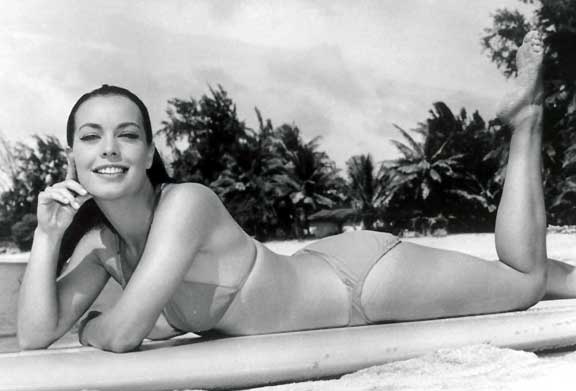
Dark haired and sultry, Susan Hart displayed her shapely body as bikini-clad beach girls or monster movie heroines in a string of popular ‘60s B-movies. It is no wonder considering her measurements were usually touted as 37-23-36 as she was being groomed to become Hollywood’s newest sex symbol. After fleeing from The Slime People (1963) in her film debut, Hart frolicked on the sand as a hula swaying, half-Hawaiian in Ride the Wild Surf (1964). She snagged a contract at American International Pictures and soon after married the boss, James H. Nicholson, the studio’s co-founder. The curvaceous starlet thought better roles were ahead for her but she was back in a bikini as a hip-shaking beach girl in Pajama Party (1964) and back to being chased by monsters—this time gill-men—in War-Gods of the Deep (1965). Donning a bikini yet again, she played a robot programmed to seduce, marry and kill a bungling playboy millionaire in the spy spoof Dr. Goldfoot and the Bikini Machine (1965). Most famously, Hart stepped in to save the last official Beach Party film, The Ghost in the Invisible Bikini (1966) as (what else?) the title bikini-clad character, before hanging up her swimsuit to raise her son.
Susan Hart was born in Wenatchaee, Washington—the apple capital of the world. When she was in the second grade her family began spending the winters in Palm Springs, California and the summers in Washington because her mother had contracted Tuberculosis. She went to high school in Palm Springs where she began acting in school plays and after graduating moved to Hawaii for a short period where she worked in a dress shop. She recalled, “I was working at the International Market Place when a fellow named Morton Smith came in one day and handed me his card. “He was an agent and also a photographer on assignment for Playboy Magazine. I didn’t pay too much attention to him but he came back and took some snap shots of me at the counter and on a surfboard. He told me that I should me in movies and to look him up if I ever got to Hollywood. It was rather exciting to have somebody praise you like that. Being a young girl, I thought, ‘It would be really nice to be in the movies.”
Susan Hart returned to Palm Springs and got a job managing a dress shop. With Smith’s words of encouragement and praise still in her head, she decided to take him up on his offer. “I went to his office and said, ‘Here I am! What am I supposed to do now?’ Within a month he sent me out on an interview for The Joey Bishop Show and I got it. I had about four or five lines.”
Hart landed an agent named Bill Schuyler who kept her busy playing small parts on TV. (“He was probably the best agent I ever had because he got me a lot of work.”) One of her roles was as a biker chick on The Alfred Hitchcock Hour. “I worked with Billy Mumy [of Lost in Space] who was only about ten years old but he was such a flirt,” remembers Susan with a laugh. “He was a darling little kid with a charming personality and he was an absolute lady-killer for that age.”
Though she only played minor roles on TV, Hart was honing her craft to make the leap to features. She screen tested at MGM but did not land a contract. However, photos of her turned up in the film Boys Night Out (1962). “They shot pictures of me to be the centerfold in a magazine that Tony Randall and James Garner open up,” reveals Hart. “This really was my first part in a motion picture. I have a towel wrapped around me and I am answering a telephone.”
In Hart’s next feature, she is not only seen but heard as well as she was cast as Robert Hutton’s leading lady in the grade-B horror film, The Slime People (1963). When asked how she landed this role, Hart answers facetiously, “Just luck, I guess.” Actually, Robert Hutton who also produced and directed The Slime People went to Hart’s agent and several other agents and asked if they had anybody on their rosters suitable for the role of Gwen. “All Bill Schuyler told me about it was that it was a reading for lead in a motion picture. At that point I still did not know the title of the film. But I did know it was going to star Robert Hutton, whom I remember my sister Helen thought was just a fabulously handsome man. I read for the role in the morning. I went to lunch with a friend and when I arrived home around four o’clock I got a call from my agent telling me that I got the part. Not only did I get a role but also my roommate, Judee Morton, was cast as my little sister. It was incredible! Even after I found out the title I thought this was still a pretty good opportunity.”
The Slime People was shot at KTLA Studios. After about nine days of filming, the cast stopped getting paid and the make-up man left. However, Hart proved to be a trouper and continued with the production. She even did her own make-up. Despite these working conditions, Susan does not look back on this film with any bad memories. “Everybody connected to this was really nice. Don Hansen was the name of the man who financed the film. As I recall, he always wore a Fedora and owned a lot of dry cleaners. Robert Hutton knew I didn’t have any experience doing films and he couldn’t have been nicer or more helpful. He practically told me every move to make and taught me about hitting your mark.”
In The Slime People, nuclear testing decimates Los Angeles leaving the city enshrouded in a blanket of fog. A small group of survivors try to make it out of the deserted metropolis while battling subterranean creatures roused from hibernation. Robert Hutton starred as a hotshot pilot with Robert Burton as a professor and Susan Hart and Judee Morton as his daughters. One of the films many unintentional laughs is that despite the fact that she is being terrorized and chased by the Slime People, Hart’s character Gwen keeps on her four-inch high heel shoes and never lets go of her oversize black pocketbook. “Isn’t that funny,” laughs Susan. “I think I still have that purse around my home somewhere. We were given something like eighteen dollars to select our own wardrobe. Judee and I went to Orbach’s and it was my decision to buy those shoes and purse. Those heels killed my feet, which were never the same again.
“A man named Tracey Putnam played the doctor in this,” continues Hart. “He was an actual doctor and had discovered a drug which keeps Epileptics from going into seizures. He was a brilliant man. His stepson, Jock Putnam, played one of the Slime People and talked his stepfather into playing one of these roles. It was a riot to see Jock and the other actor who played the Slime People sitting on the set smoking a cigarette. You’d see smoke pouring out of all of the orifices of these gigantic costumes.”
httpv://youtu.be/SxnfowaIutg
The ad copy for The Slime People proclaimed, “Up from the Bowels of the Earth Come …The Slime People.” Needless to say, the film did not receive rave reviews. It is no wonder then Hart tried to distance herself from this as much as she could. “Now talking about The Slime People is fun,” admits Hart. “But a few years after making it I kept thinking that The Slime People was a terrible movie to be associated with. It was a mediocre movie and didn’t play in many theatres. The reviews weren’t very good if it even got reviewed at all.” To keep journalists from asking about the film, when Hart landed one of the lead roles in her fourth movie, Ride the Wild Surf (1964) it was touted as her first starring role.
On the big screen if you blinked you missed Hart’s bit in her next movie, the Bob Hope comedy A Global Affair (1964). The audience would have seen more of her in a locker room scene but she balked at doing it. “I remember working with Barbara Bouchet and Brenda Benet on this,” says Susan. “Brenda was a very moral girl. When the director told us we had to strip down to our bras we both called our agents and screamed, ‘You didn’t tell us we had to take off our blouses!’ We both got dismissed from the film. I didn’t feel that they were paying me enough money to do that.” That same year, Hart turned up along with Nancy Sinatra and Claudia Martin as one of Pamela Tiffin’s sorority sisters in the beach film For Those Who Think Young (1964).
The movie though that put Susan Hart in the spotlight was another beach film, Ride the Wild Surf (1964), which was Columbia Pictures answer to AIP’s Beach Party. Aficionados consider Ride the Wild Surf one of the best from the genre because of the awesome surfing footage. Three California surfers travel to Hawaii during Christmas vacation for the yearly surfing event at WaimeaBay. Recent college dropout Jody Wallis (Fabian) debates the life of a surf bum versus returning to school and falls for Brie, a vacationing coed (Shelley Fabares, sporting bitchin’ blonde hair) not impressed with his quitter’s attitude. Reliable, down-to-earth Steamer (Tab Hunter) falls in love with a beautiful island girl named Lily, sweetly played by Susan Hart (“I didn’t quite look the part but I guess it worked out all right”), to the consternation of her stern and disapproving mother (Catherine McLeod). Staid law student Chase Colton (Peter Brown) is attracted to the playful, athletic Augie Pool (Barbara Eden) who teaches him to loosen up.
Before filming officially began, Susan Hart, Peter Brown, and Jim Mitchum (who played rival surfer Eskimo) went over to Hawaii three to six weeks before the rest of the cast and crew. Hart recalls, “The producers sent me to Hawaii to learn to ride a horse. First they put me on a pony and then I worked my way up to a decent-size horse. Everyday they had me out in the cane fields learning to ride. I got pretty good. When we finally got to film my one scene where I come riding down the beach they brought in this huge horse that Charlton Heston rode in the film Diamond Head. They dressed me in white shark-skinned pants and they oiled the horse down pretty good to make him look beautiful. But there was no way I could stay on the horse. I kept sliding right off. They ended up double space taping me on to the horse. To get me off they actually had to peel me off of it.”
httpv://youtu.be/AIWqIBLzCeM
Though Ride the Wild Surf did not prove as popular as Beach Party, it was still a hit. And with the good notices received by the cast Columbia took action. According to Hart, “I think everybody in Ride the Wild Surf was put on a six-month option. Mike Frankovitch, who was the head of the studio at that time, always had great faith in me. About the fifth month of my term with Columbia I went over to AIP and that is when I met Jim Nicholson.” Unbeknownst to her, Nicholson had access to the dailies of Ride the Wild Surf and that is the first time he saw Susan Hart. “After we met that ended any pursuit I had to sign a contract with Columbia because not only was I offered a contract with AIP through Jim, but there was a bit of chemistry between the two of us.”
After signing with American International Pictures, Hart was cast in the small role of Jilda in Pajama Party (1964), starring Tommy Kirk and Annette Funicello. This was a bit of a comedown from her much bigger role in Ride the Wild Surf. “Once you go under contract they can put you in anything they want,” sighs Susan. “I don’t know whose idea it was to put me in Pajama Party but I never questioned it. I never questioned a lot of things.” Hart doesn’t have many lines in the film but she is a standout nevertheless wiggling her curvaceous bikini-clad body, which obviously got the motors running of the surfer dudes in the movie and the teenage boys watching in drive-ins across the nation.
Also in 1964, AIP chose Susan Hart as their Hollywood Deb Star. Interestingly, of all the Hollywood Debs that year, including Mary Ann Mobley, Brenda Benet and Claudia Martin, only Raquel Welch clawed her way to super stardom. Hart opines, “For an actress to become a star in the sixties you had to have great determination. However, everybody has a different story. You may have the determination but it may not have been a lasting determination. Or you may have had the determination but it is too difficult to follow through. You have to give up an awful lot because something will suffer along the way. You pick which part of your life is going to suffer. I think Raquel Welch did have that boundless resolve and I imagine that she wanted stardom more than anything—and she got it.”
Susan Hart also with great fanfare became part of AIP’s Starburst of Youth program. When asked to explain exactly what that was, Harts says with a laugh, “I suppose it was a great title—another Jim Nicholson creation—but I think it was primarily for the exhibitors. I remember at the Ambassador Hotel in Los Angeles one weekend it was filled with theatre owners from all over the nation. It was called Starburst of Youth. We put on a show for them. Several of the girls were in bikinis. We mingled and had our pictures taken with them. It was more of a promotional gimmick than a real program.”
httpv://youtu.be/Fo8SrycaTFE
Back on the big screen, Hart starred in her next two features for AIP. The fantasy film War-Gods of the Deep (1965) reunited her with her Ride the Wild Surf co-star, Tab Hunter. (“I was so happy when I was told Tab Hunter was going to play my leading man,” exclaims Hart.) The film was inspired by the poems “City Under the Sea” and “A Descent into the Maelstrom” by Edgar Allan Poe. Set in the turn-of-the-century, Hart played Jill Tregellis, a young American lass who owns a converted manor house hotel on the Cornish coast of England. In the middle of the night, she is dragged off by ancient gill-men to an underwater city called Lyonesse complete with a tyrannical ruler called The Captain (Vincent Price), his cadre of thieves and a threatening volcano. Life in Lyonesse is eternal except for people who commit a crime and then are thrown to the gill-men. The Captain thinks Jill is his reincarnated wife as her daffy artist friend (David Tomlinson) with his chicken Herbert and a hunky American guest at the hotel (Tab Hunter) go to her rescue.
Recalling Vincent Price, Hart remarks, “He was quiet and pretty much stayed to himself. In private, he was pretty much as he appeared on screen in terms of his delivery and attitude. He and Jim Nicholson got along really, really well. We had dinner on several occasions with him. Vincent was the consummate gentleman.”
The reviews in 1965 for War-Gods of the Deep were mixed. Though most critics at the time found it entertaining and thought Vincent Price was excellent, the film was hampered by a weak script, unfunny comic relief by Tomlinson and that annoying chicken, and less-than-convincing performances by Hart and Hunter.
Susan rebounded from the water-logged Jules Verne-ish tale to give an amusing, well-received performance as a bikini-clad robot in Dr. Goldfoot and the Bikini Machine (1965), a goofy take-off on the James Bond film Goldfinger co-starring Frankie Avalon and Dwayne Hickman. (“Both of them were charming and pleasant to work with.”) Surprisingly, this spy spoof was quite entertaining and grossed $2.5 million, a smash hit for AIP standards.
Dr. Goldfoot and the Bikini Machine (1965) was filmed on location in San Francisco by director Norman Taurog. The script was by Elwood Ullman and Robert Kaufman, based on a story by James Hartford. The film stars Vincent Price as mad scientist Dr. Goldfoot (named for his wearing of gold slippers) who plans on capturing the fortunes of the world’s richest men with the aid of his invention. As lights blink, dials wiggle, horns blow, and the machine vibrates manufactured bikini-clad robots (Patti Chandler, Salli Sachse, Deanna Lund, Luree Holmes and Marianne Gaba, among them) are produced one by one. Hart played Goldfoot’s most prized robot, No. 11 named Diane, who is sent out to entrap playboy millionaire Todd Armstrong (Hickman) but is hampered by the bumbling of inept Secret Agent 00.5 Craig Gamble (Avalon).
Budgeted at $1.4 million dollars, Dr. Goldfoot and the Bikini Machine is quite elaborate for an American International production. According to the press notes more than $150,000 was spent on creating “a haunted palace, a pit and a pendulum, and an electronic device that manufactures a dozen beauties in bikinis.” And if you watch closely you can spot cameos from AIP stars Annette Funicello, Deborah Walley, Harvey Lembeck, and Aron Kincaid.
The film also has an interesting pre-release history. It was to be originally titled Dr. Goldfoot and the Sex Machine and was conceived as a musical along the lines of the Beach Party movies. The first to go was the title, which was a bit too risqué for 1965. The film was shot with only one musical number in place but it was excised prior to the film’s release. “That musical number was left on the cutting room floor because Sam Arkoff thought Vincent Price was too fey in it,” discloses a disappointed Hart. “It was a fabulous production number with Price singing and dancing around the bikini machine. The lyrics went something like ‘I have a machine. I have a bikini machine—a most marvelous invention.’ I would love to see that footage because Vincent Price had never done anything like that before. The whole point was that he played it campy because Dr. Goldfoot was a silly doctor. Vincent Price just acted the role to the hilt and he was quite wonderful.”
Hart proved to be a talented comedienne and handled the pratfalls in the movie excellently. As Diane is programmed to speak many different languages, Hart used an array of accents (including Southern, French, British, etc.). “Nobody helped me with most of these dialects,” states Susan proudly. “I simply mimicked and learned it all on my own except for one. AIP hired a coach for one day to help me master the Japanese dialect. A Japanese girl went over and over the lines with me until I got the dialect down pat.”
The extra coaching paid off and Susan Hart received very good notices for her performance. Variety, in particular, raved, “Susan Hart is very good in a role which demands several dialects, human warmth, and robot inanimity, often in rapid sequence.” Hart credits her well-received performance to director Norman Taurog. “He had so much faith in me and he thought I was terrific,” says Hart fondly. “Norman Taurog boosted my ego. I don’t know if he did that with other actors but it was a great ploy. I had so much confidence in myself because of him. He was the type of director really made you feel that whatever you were doing, it was right. I do not think I had anybody speak to me and assure me the way he did to make me feel completely at ease. I was never nervous before a shot, which I usually had the tendency to be. Norman Taurog completely calmed me down because he would say if it was not right the first time we’d just do it over again until we got it right. Therefore, it was generally one take because he instilled a confidence in me. I will always be grateful for that because it crossed over into many things.”
To promote the film, an hour special entitled The Wild, Weird World of Dr. Goldfoot was produced and aired in place of Shindig. It featured Price, Hart, Tommy Kirk, Aron Kincaid as a last minute replacement for Frankie Avalon (“He backed out because his contract with AIP did not require him to do TV”) and some of the bikini girls. “They needed a half-hour fill-in for Shindig and I think Deke Hayward came up with this special on his own,” recalls Hart. “He wrote it and it was not the same music that was cut from Dr. Goldfoot and the Bikini Machine. It was different songs written by Guy Hemric. I sang in it with Aron Kincaid.” The duo performs “What’s a Boy/Girl Supposed to Do” and “Lower, Lower.” Their duets are not half bad considering the short amount of time they had to prepare for it.
After garnering much praise for Dr. Goldfoot and the Bikini Machine, the red hot Hart was much in demand. But her pregnancy and marriage to Jim Nicholson sidelined her. After the birth of her son, there was much talk of Susan Hart appearing in the Italian production Planet of the Vampires and a proposed sequel to Dr. Goldfoot and the Bikini Machine to be titled Dr. Goldfoot and the S Bombs. For reasons she can not remember, she didn’t do the former film and the latter was re-titled Dr. Goldfoot and the Girl Bombs (1966) and filmed in Italy by director Mario Bava with only Price reprising his role.
Very rare clip of Susan Hart on Australian Bandstand promoting Dr. Goldfoot. She comes on around the 7:30 mark.
httpv://youtu.be/9aj08k09ev4
For her next film, Susan Hart deserved better than yet another bikini role as she was cast as The Ghost in the Invisible Bikini (1966). Asked if she felt that the studio exploited her body, Hart responds, “When you are living something, you don’t question it. It’s only when you look back in retrospect that maybe you think, ‘Oh gee, I should have done this.’ All I knew was that I was working as an actress—which was my intention. When I was in my twenties I was not very introspective so I didn’t question what I was doing very much. I was the type of person who had to be active all the time. All the roles I was offered were body-type roles. I didn’t know how I could ever get out of that. That always plagued my career. I didn’t know how to get what I called a real part. And maybe I never would have. I was only offered roles that exploited my body. Unfortunately, that’s only how people saw me. I suppose that is what I projected.
“Hugh Hefner wrote me to pose for Playboy,” continues Hart. “He was very flattering and mentioned that Stella Stevens was a Playmate and she went on to do great things. I turned him down but at one point was I actually entertaining the thought of doing it. But then I got a good part in something and changed my mind. I recently read one of the letters he sent me and there is a line in there that says ‘If you ever change your mind, please let me know.’ I wonder if it is too late?”
httpv://youtu.be/s_b75WofGcs
The Ghost in the Invisible Bikini was originally titled Bikini Party in a Haunted House and was not supposed to feature Suan Hart. Tommy Kirk and Deborah Walley topped a cast that included Aron Kincaid, Quinn O’Hara, Nancy Sinatra, Claudia Martin, Piccola Pupa, Bobbi Shaw, Ed Garner, Luree Holmes and veterans Basil Rathbone, Patsy Kelly and Jesse White. Kirk and Walley must spend the night in a haunted house in order to collect their inheritance, hidden somewhere in the creepy mansion complete with a chamber of horrors, an escaped gorilla, surfer boys and bikini girls and Eric Von Zipper with his biker gang. The weak film was deemed unreleaseable by AIP and a quick fix was needed. “Jim came up with the idea of having a ghost in the invisible bikini,” reveals Susan. “I got the part about three days before they began shooting it. I was a very quick study.”
Boris Karloff and Hart were added to the cast to play, respectively, millionaire Hiram Stokely and his sexy blonde wife Cecily. The recently deceased Hiram must perform a good deed to get into heaven and as a bonus is promised eternal youth. Cecily, who died as a young woman, is sent down to Earth to make sure Hiram’s rightful heirs inherit his money. Their scenes together were tacked on to the beginning and the end of the film.
Hart was wasted in The Ghost in the Invisible Bikini and unfortunately this was her last feature. A number of things contributed to that including the caring of her son and the problems that arose between Jim Nicholson and Sam Arkoff. “At first, Sam Arkoff was great fun to be around because he had a wonderful sense of humor. We ended up traveling to foreign countries quite a bit together. AIP always had co-productions filming in Germany, Spain and especially England. We spent a lot of time abroad with him and his wife, Hilda. Of course, he and Jim were equal partners at that point so it was a very good time. When Jim had to give up shares of his stock [to his wife in a divorce settlement] Sam became the majority stockholder and that’s when things began to become strained.
“It was so difficult to continue acting under those circumstances,” continues Susan. “It was too complicated for me to work. I was happily married and I had had my son Jimmy. I thought that when Jimmy got a little bit older I’d go back to acting. That was always in the back of my mind. I’d say, ‘Once Jimmy is in the first grade I’ll go back to work.’ But between caring for him and trying to move on—I always wanted to be a singer—I thought I’d try focusing on that instead of acting. I did cut several songs for MGM and went on the road to promote them.”
Hart ‘s final acting role was in “The Night of the Fugitives” (11/8/68) on TV’s The Wild Wild West. Hart (resembling and sounding a lot like actress Yvonne Craig) played Rhoda the glamorous double-crossing owner of the Diamond Horseshoe Saloon (“When a girl, um, does a favor she should get a favor–like they always say quid pro quo.”) who is searching along with everybody else for bookkeeper Norbert Plank’s syndicate records. But this episode is more notorious for the almost fatal head injury suffered by series star Robert Conrad while doing one of his own stunts on a landing above a saloon.
Though Susan Hart left AIP, Jim Nicholson continued with the company until 1972 when he signed a deal with 20th Century-Fox. He was the executive producer of The Legend of Hell House (1973) and was readying Dirty Mary, Crazy Larry (1974) for production when he was diagnosed with a brain tumor. He passed away on December 10, 1972 before The Legend of Hell House was released.
As for her feelings regarding Jim Nicholson’s contribution to AIP, Hart proudly comments, “He was the creative genius and essence behind American International Pictures. Jim was the show and Sam was the business. Jim started every trend AIP ever had from the biker pictures to the Poe pictures to the beach pictures to the blaxpoitation pictures.”
Sam Arkoff held on to the company until 1979. He sold it to Filmways, which was bought by Orion. Today MGM-UA holds the rights to all of the AIP movies except the forty-two films in the limited partnership that Nicholson and Arkoff formed during the fifties. These films were divided up between Arkoff, Susan Hart and Nicholson’s daughters. Through a court decision, Hart won the rights to some of the more popular titles including I Was a Teenage Werewolf, I Was a Teenage Frankenstein, Invasion of the Saucer Men and It Conquered the World.
Today, the still beautiful Susan Hart resides year-round in Palm Springs and was just awarded a “Star” on the Palm Springs Walk of Stars. It is a fitting tribute to this talented and popular actress who never got the chance to progress beyond her bikini roles.
[amazon_enhanced asin=”0786472979″ /][amazon_enhanced asin=”0786415754″ /]

 In 1969, adolescent boys could be found sitting in front of the television on Sunday nights enthralled by the sci-fi series LAND OF THE GIANTS. Created by Irwin Allen, the show focused on seven people stranded on a planet identical to Earth except everything is twelve times bigger. Though the special effects were impressive, most boys were captivated by the antics of red-haired, mini-skirted actress Deanna Lund as intergalactic castaway Valerie Scott. During the course of the series, Deanna’s character is menaced by cats; imprisoned in a dollhouse; cloned; prodded by scientists; carried off by an ape; and even used as a human pawn on a giant’s chessboard. Of all the actresses who toiled in sixties sci-fi television Lund was arguably the only one who portrayed more than a one-dimensional character. She was able to bring real strength to her role, as Valerie evolved from selfish party gal to likeable team player. Lund made the transition beautifully, giving skilled performances. With a mane of red hair and clad in the shortest of mini-skirts, Lund was perhaps every young teenage boy’s first crush at that time—me included!