Sixties actor Mike Nader just celebrated a birthday so I thought I would pay tribute to the former surfer who stayed afloat in Hollywood long after the tide washed away the Beach Party movies. Tall, slim, athletic, with dark haunting features Mike immediately took to acting and the camera took to him. Nader was just a part of the beach crowd in Beach Party (1964) and the first few sequels. He graduated to featured player status with roles in Beach Blanket Bingo (1965), Ski Party (1965) and How to Stuff a Wild Bikini (1965), and on TV opposite Sally Field in the sitcom Gidget.
Michael Nader was born in St. Louis, Missouri on February 18, 1945. When he was a small child his family relocated to Beverly Hills, California. He attended Vista Grammar School and Beverly Hills High School where he became friendly with Ed Garner. However, Nader was not part of that Beverly Hills crowd of mansions and Porsches. His family lived in an apartment and he drove an old Woodie. At school, his rebellious demeanor was forever getting him into trouble. Surfing was his only escape. He remarked in TV Guide, “You got a pair of trunks, the ocean, a board under you—and no regulations.” Nader began hanging out with that legendary Malibu surfer crowd that included Mickey Dora and Johnny Fain.
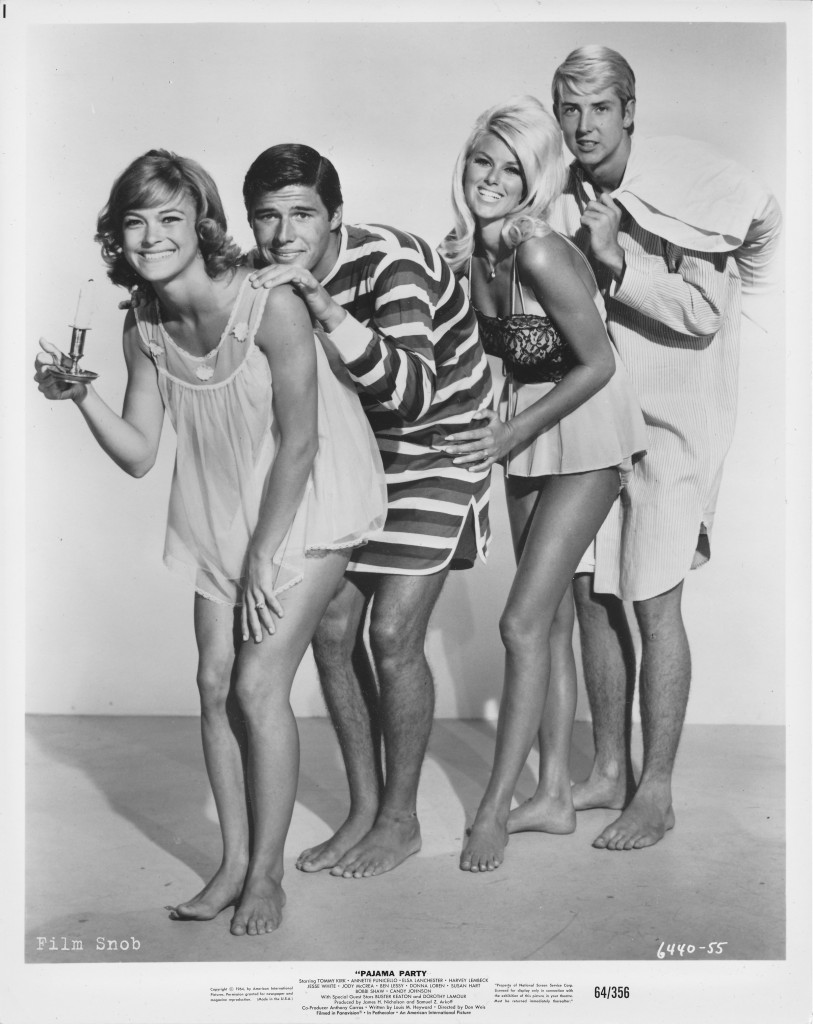
Mike Nader was apart of the group of friends that Ed Garner introduced to director William Asher to surf double and populate the background in Beach Party (1963). Asher immediately took to the young surfer and gave him lots of screen time. Though he didn’t have many lines, Nader had a charisma that came across on the screen and made him a standout from the rest of the crowd. Nader remained part of the contingent of surfer boys in Muscle Beach Party (1964), Bikini Beach (1964) and Pajama Party (1964) but he began studying acting with guidance from Harvey Lembeck.
He finally broke free from the surfer boy pack in Beach Blanket Bingo (1965). With John Ashley playing Frankie Avalon’s rival, this left the best friend role vacant. Nader was then cast as boyish Butch, loyal buddy to Frankie and boyfriend of the amorous Animal played by Playboy Playmate Donna Michelle. However, his bromance moment with surfer Johnny Fain feeding him weiners during Donna Loren’s moment singing about unrequited love stands out.
In Ski Party (1965) Mike played college guy addle-brained Bobby, who with Steven Rogers as his pal, try to make time with Bobbi Shaw’s Swedish ski instructor. Yah! Yah! In How to Stuff a Wild Bikini (1965) he was once again the boyfriend of Animal, now played by yet another Playboy Playmate Marianne Gaba, though his character was named Mike. With Frankie away on naval reserve duty, Mike’s loyalty switched to Frankie’s best friend, Johnny. In all his movies, Mike knew how to shake his cute booty and was always featured front and center during the dancing sequences.
https://www.youtube.com/watch?v=8A-PZcOr_P8
In the fall of 1965, Nader played the recurring role of Peter Stone on the Gidget series starring Sally Field from 1965-66. After finishing out his contract with AIP by playing Joey in the action film Fireball 500 (1966) with Frankie and Annette trading their surfboards for stock cars, Nader headed for New York. He was accepted into Lee Strasberg’s Actors Studio and for the next ten years he studied and performed in Off-Broadway plays. To earn money he waited tables and as with other beach party veterans such as Aron Kincaid and Salli Sachse he began modeling.
 In 1976 Nader was cast as Kevin Thompson, a proposed love interest for the soap’s resident suffering antagonist and lush Dr. Susan Stewart (Marie Masters) in the daytime drama As the World Turns. He described the character as “a mysterious unknown entity.” When his contract ended in 1978 (his character, after helping Susan sober up, was killed off), Nader abandoned New York for Hawaii to surf and to reevaluate his life.
Instead of returning to the Big Apple, he decided to move back to Los Angeles in 1981. He landed the role of handsome Greek Alexi Theophilus in the short-lived 1983 primetime soap Bare Essence starring General Hospital cast-off Genie Francis (ex-Laura) proving that daytime popularity does not guarantee primetime success. He then beat out Dino Martin and Jon-Erik Hexum, among others, for the role of sexy and suave Dex Dexter who stole the heart of Joan Collins’ Alexis Carrington Colby on Dynasty from 1983-89. Nader commented in Hollywood Drama-Logue, “I didn’t have the look they wanted. I was the only one with a dark Mediterranean look. But Joan and I clicked with the spirit they wanted.” His love scenes with Collins smoldered across the small screens of America. The role made Mike Nader an international TV star. He was voted one of the sexiest men of the decade and was chosen to play Susan Lucci’s leading man in the TV-movie Lady Mobster (1988).
After Dynasty ended, Nader appeared in a few forgettable TV movies including Nick Knight (1989) and The Flash (1990), and the miniseries Lucky/Chances (1990). In 1991 he joined All My Children as the mysterious count Dimitri Marick paired with Lucci’s Erica Kane and had another long run playing the part until 1999 when his role was written out. However, the fans were outraged and flooded the network with complaints. The soap rehired Nader in 2000 only to fire him a year later due to his arrest for possession of and selling cocaine at a social club. The charges were reduced to misdemeanor possession and Nader entered a treatment program admitting to his drug and alcohol abuse. Despite his taking responsibility for his actions, the producers of All My Children still refused to take him back after a nine-month recovery period. Nader remarked to the New York Post, “And I was shocked because, you know, it hurts.” He filed a lawsuit but it was thrown out of court. He returned to an online reboot of All My Children in 2013 reprising his role. Unfortunately, the show was officially declared dead after short one season. This was Nader’s last known acting role.
Mike Nader is featured prominently in my book Hollywood Surf and Beach Movies: The First Wave, 1959-1969.