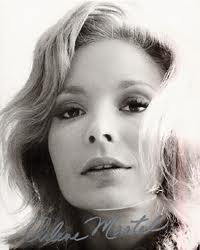
RIP Arlene Martel

AMOvershadowed by the sad loss of Robin Williams and Lauren Bacall, 1960s starlet Arlene Martel also passed away this week from a heart attack. I had the pleasure to interview Arlene for my book Drive-in Dream Girls. Below is an excerpt from it including some of her quotes. She will be missed.

Arlene Martel was one of the many talented Hollywood actors whose face fans recognize but whose name may elude them. In her case it’s even more so since she started out in Hollywood using her real name of Arline Sax. On the big screen Martel had the female lead in the cult film noir The Glass Cage (1964) and played a biker chick in the popular film Angels From Hell (1968), the follow-up to Hell’s Angels on Wheels (1968). But it was on TV where Martel excelled essaying a variety of roles usually hidden under different hair colors and gobs of make-up or speaking in a foreign dialect in such series as Route 66, The Twilight Zone, The Outer Limits, The Man from U.N.C.L.E., Hogans Heroes, Star Trek, The Monkees and Bewitched. The exotic, shapely beauty played so many varied roles that she was dubbed “the Chameleon” by honchos at Universal Studios. “I think this was a hindrance because no one knew it was the same actress from week to week,” commented Arlene. “In fact, in one week I was on three different shows. And nobody knew it was the same person. I think it is very good to have that versatility when you are established as a star. They say, ‘Look she can do this and do this.’ But if the audience doesn’t know it’s you, it is not to your advantage.”

Her comments on some of her most memorable 1960s TV appearances.

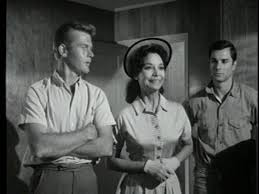
Route 66 “A Legacy for Lucia”

“This was written by Stirling Silliphant so you can imagine the quality of the writing. I played a young Italian girl who meets this American soldier in Italy. Trying to impress her, he tells her that he owns the state of Oregon and if anything happened to him he’d leave it to her. He dies and she comes to America to claim her property. It was a very touching and beautiful experience. We actually shot it in a lumber camp in Oregon. I still feel the air on my face and I still feel the passion that surrounded this character. Both George Maharis and Martin Milner were just lovely to work with.”
AM R66

The Outer Limits “Demon with a Glass Hand”

“When I first read Harlan Ellison’s script I felt inspired by it. I felt I could do a lot in the role of Consuela. This part had a lovely substance that I connected with. Byron Haskin was our director and he was wonderful! He was the reason I got this role. When they replaced me with Christiane Martel [in the 1959 movie The Little Savage], Byron told me, ‘One day I will make it up to you and find something else for you.’ And sure enough he did.”

“I believe Harlan Ellison was on the set during filming but to tell you the truth my concentration was so much on my part that other than Robert Culp I don’t think I was aware of anyone else. I was very focused on what was happening between our characters.  I found Culp to be very attractive in many ways. I got a very beautiful feeling about him. I thought that as a person he projected a lovely sanity. I enjoyed working with him. He remains a favorite.”

“I also had an operation and had just been released from the hospital the day before. If you watch the episode you’ll notice that as I am being pulled by Robert Culp I am running very stiffly with my arm at my side because I was nervous that the stitches would open. I was running in so much pain—up the stairs, down the stairs—but I was afraid to tell them that I just got out of the hospital because I thought that they would replace me. I kept that to myself and just prayed, ‘Oh dear God please don’t let me start bleeding all over the place.’”

AM OL

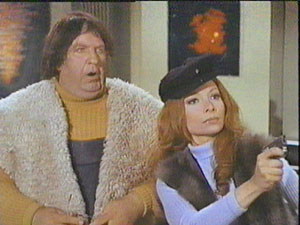
The Monkees “The Spy Who Came in from the Cool”

“The guys were having a ball doing this series. I had an especially good rapport with Peter Tork and Davy Jones. There was a great deal of joviality on the set. I hung out with them one day and it was the first and only instance where I wasn’t on time getting back to a set. The air was thick with smoke and I guess I innocently inhaled. I was twenty minutes late and the director berated me mercilessly in front of the cast and crew.”
AM M

Star Trek “Amok Time”

“[Director Joseph] Pevney kept guiding me towards doing less and less and less [playing a Vulcan betrothed to Spock]. Finally he said, ‘Do even less than what you’re doing.’ I said, ‘But I wouldn’t be doing anything at that point.’ He replied, ‘That’s exactly what I want. It will come through.’ So this very dry, icy, intellectual quality came forth and that is exactly what he was after. But it was very different from everything else I had done.”

“Every time Celia Lovsky pronounced one of the Vulcan words Bill Shatner would whisper something funny about it and get me to laugh, which was terrible to do. It was just terrible of him! Of course Ms. Lovsky wasn’t aware of this. But she had difficulty pronouncing the Vulcan words. Bill was like a naughty schoolboy and suddenly I became five years old too. At one point, the director threatened to throw us both off the set. I have very good concentration but Bill just broke me up.”

“Leonard Nimoy was rather removed. Maybe he was maintaining his character—I don’t know. Or maybe he genuinely didn’t like me! I have no idea to this day. We were cast together in three different shows. Before Star Trek we played a mountain couple in the western The Rebel with Nick Adams and I also worked with him later on Mission: Impossible. I thought I was very good to work with and that I gave a great deal in my work. For some reason, he remained very aloof.”

AM ST


ANOTHER HARROWING MEMOIR FROM A 1960S ACTRESS

sharon-farrell-1If I thought Diane McBain had a harrowing life that she wrote about in Famous Enough, it does not compare to what her 1960s contemporary Sharon Farrell revealed that she went through in her fascinating memoir Sharon Farrell “Hollywood Princess” From Sioux City, Iowa: The “Bad Girl’s” Story. First the simularities: both are pretty blondes who were two of the most promising starlets of the 1960s; both had one son from short-lived marriages; both saw their chances for super stardom fade away; both did drugs; and both were rape victims. But for every horrible incident that befell Diane McBain, Sharon Farrell’s was even worse.

As someone who loves reading (and writing) about the back stories in making movies or TV shows, Sharon does not disappoint with her career highlights such as Marlowe with Bruce Lee; The Reivers with Steve McQueen; The Last Ride of the Dalton Gang with Jack Palance; Out of the Blue with Dennis Hopper; The Stunt Man with Peter O’Toole; and her stint as a regular on Hawaii Five-0 during its last season. However, most are unhappy experiences and depressing to read as she is used and degraded (physically and/or psychologically) by practically every leading man and then tossed away once filming stops. She gets credit for not holding back and depicting herself in a very unflattering manner, but as you keep turning the pages you just hope she finds happiness. Instead the drug taking and sexual abuse by many hideous men continues and also because she foolishly binds herself to a man who took so much advantage of her stealing her money and forcing her to relocate to Fiji. Finally free of him and back in the States, Sharon finds herself committed to a psycho ward in California, which is really hard to read considering what she was put through.

What is most amazing to me despite the living hell she was going through in the 1970s and 1980s, is that she worked pretty consistently and got some really good parts well into her forties doing better than her more stable 1960s contemporaries for sure. This was due to her acting talent and her professionalism on the set despite what was happening to her off-camera.

Though Sharon highlights her major films/TV shows, her body of work is tremendous and I would have liked to have read more about them and less of the sex/drug tales she shares. Being self-published, the book is at times a bit disjointed and contains misspelling and such. Even so, I still recommend the book to fans of Sixties actresses and the New Hollywood of the late 1960s (let’s hope actresses in the Golden Age of Hollywood weren’t treated this shabbily). The fact that Sharon Farrell survived all she did and is still alive to tell about it is a testament to her strength and courage. Kudos to Sharon for persevering.

[amazon_enhanced asin=”1477511113″ /][amazon_enhanced asin=”1593935765″ /]

MOLLS OF BATMAN: EILEEN O’NEILL as MILLIE SECOND

When I began interviewing 1960s starlets in the late nineties I always asked them about working on TV’s Batman, if they had on their list of credits. It was one of my favorite TV shows as a kid. Though the villains stole the show, I always took a special liking to the dastardly dames by their sides. Some of the most beautiful starlets of the day donned miniskirts to catsuits to fabulous furs to help their man defeat the Caped Crusader. Some repented for their greedy ways while others went down swinging. My next couple of Blogs will pay tribute to some of them in honor of the upcoming DVD/Blu-Ray release FINALLY of Batman this Fall.

First up sultry brunette Eileen O’Neill as the Clock King’s cleverly named moll Millie Second who was one of Batman’s most eager crooked gals who seemed to just revel in her boss’ sinister schemes. Awed by his cleverness, she even calls him Your Highness, but her character, who had a lot of potential, is wasted and not given much to do.

eon

In “The Clock King’s Crazy Crimes” and “The Clock King Gets Crowned,” which originally aired on October 12 & 13, 1966, viewers are introduced to Gotham City’s newest multi-wrist watch wearing villain as he and his moll Millie Second watch the goings-on at a high-end jewelry store through a hidden camera planted in an antique clock. The Clock King then releases knockout gas as his thugs nicknamed the Second Hands race in and make off with diamond bracelets and necklaces. When Millie Second, clad in a mod striped green and blue mini-dress and always holding a feather duster, gets a peak at all the jewels she coos, “Just look at all these goodies! They’re marvelous Clock King.” Unfortunately, Millie Second is AWOL for the rest of the episode (guess someone had to stay behind and dust all those clocks).  She doesn’t even show up after Clock King captures the Dynamic Duo and puts them in a giant hourglass complete with the sands of time pouring in on them.

With time ticking away, Batman and Robin are able to knock over the hour glass and then like squirrels in a cage roll it out onto the street where they are freed. Unaware that his arch enemies are alive, Clock King boasts of their death at his hands as an enamored Millie and his Second Hands clap in approval. The egotistical thief then makes his final plans to crash Wayne manor to steal the millionaire’s collection of antique pocket watches. “This sure is tingly,” exclaims an excited Millie as they view the goings-on at the mansion through a clock Aunt Harriet bought as a birthday gift for Bruce. Frustratingly, Millie stays behind again to do her housework as the men folk go on their crime spree. She finally does go along for the big score when The Clock King plans to gas the entire city while he hijacks an incoming helicopter transporting a cesium clock. This was the time Millie should have stayed back as the Dynamic Duo ruin his plans. The only time left for Clock King, Millie Second, and the Second Hands is the time they are going to serve in the Big House.

Given more screen time, Millie Second could have been one of the series’ most memorable molls instead of just pretty decoration. Eileen O’Neill definitely had the acting talent to do more as shown by her numerous TV and movie appearances during the sixties. To read more about her, catch my book Fantasy Femmes of Sixties Cinemanow available in revised soft cover edition. Below are Eileen O’Neill’s remarks about working on Batman from it:

“Walter Slezak [the Clock King] was another kind man.  We spent so much time talking.  I sensed an effort on his part to share his richness and experience in the theatre with me.  We had extensive conversations on acting.  Again, I appreciated the knowledge you can incur like a sponge when you have an opportunity to talk to people who are so good at what they do.”

“Burt [Ward] and Adam [West] were professional and so much fun to work with.  They both jumped into the zany spirit of their roles.  They played their parts to the hilt and that is why Batman was so successful in its day.”

Next Bat Time, Next Bat Channel: Tisha Sterling as Legs Parker

[amazon_enhanced asin=”0786461012″ /][amazon_enhanced asin=”0786408685″ /]

Niki Flacks, ex-Karen Martin Wolek, Remembers One Life to Live

NFFans of the now departed soap One Life to Live remember the character Karen Wolek (the doctor’s wife-turned-prostitute-turned-baby switcher) from 1976-1983 played most famously by 2 time Emmy winner Judith Light. However, when the soap premiered there was another character named Karen that snagged Dr. Larry Wolek first. Theater actress Niki Flacks had just co-starred on Broadway with Walter Pidgeon, Arlene Francis, June Havoc, and Pamela Tiffin in the Broadway revival of Dinner at Eight. [You can read her recollections of this show in my new book Pamela Tiffin: Hollywood to Rome, 1961-1974.]. Soon after, she was cast as grasping nurse Karen Martin in a new ABC-TV daytime soap called One Life to Live created by Agnes Nixon.

When not caring for patients, Karen Martin had her sights set on handsome young doctor Larry Wolek (Paul Tully briefly followed by James Storm). He however was in love with fragile rich girl Meredith Lord (Trish Van Devere followed by Lynn Benesch), whose father Victor disapproved of the relationship and was pushing his daughter to marry Dr. Ted Hale. Larry discovered that Meredith was suffering from a dangerous blood disease, but kept it secret from her. When Ted found out, he and Larry argued. Hale took a tumble down the stairs and died. Karen heard the argument and being spiteful testified against Larry. He was eventually cleared and Meredith learned the truth about her illness. She ran off to California leaving Larry in the hands of manipulative Karen who professed her sorrow through crocodile tears in regards to her testimony. This did not bring Larry and Karen together, but when she risked her life to safe him after he was caught in a fire the two drew closer. After his bandages were removed (and new actor Michael Storm took over), the couple drew closer and made love. Karen thought it was now smooth sailing to the altar, but sad sack Meredith Lord returned to town. With her health improving, she declared her love for Larry and the two reconciled–for a moment anyway. Karen discovered she was with child and threatened to end the pregnancy if the good doctor did not to right and make her his wife. Trapped, he agreed. Shortly after tying the knot, Karen miscarried and Larry sprinted to the nearest judge to end the marriage. Not wanting to work at the hospital with Larry knowing he was with Meredith, Karen chose to leave town never to be heard from again.

httpv://youtu.be/HWGjctwkBM0

What do you recall about the early days on One Life to Live?

I was one of the original actors on the show. Agnes Nixon was brilliant. She is a genius. It was beautifully produced by Doris Quinlan. She was just so top notched. She hired wonderful directors and was very closely involved. Evertything was done on a really high level.

Was the show shot live when it began?

We did not shoot live, but on tape. However, editing tape in those days was expensive so you had a lot of pressure to do it as if it was live.

One Life to Live came right at of the gate breaking new ground with its controversial storyline about light skinned African American Carla Gray (Ellen Holly) who passed herself off as white.

We were all very aware that we were breaking new ground with the diversity and were very proud of it. Ellen Holly had established herself as one of the best stage actresses of her generation. She broke ground constantly, doing Shakespeare and other classics as a Black actress. I adored her! I know that ultimately she felt ill-used by the show and story lines. But those first years were very exciting for all of us, including her. I also became very close to the actress playing her mother [Lillian Hayman]–a wonderful character actress. Seeing the Black faces as we would sit around the table doing our first read-through of a script certainly gave me a thrill. Remember, this was the 60’s. We had protested during college and supported the sit-in’s happening in the south. And during my years on the soap I remember wearing a black arm band in protest of the Vietnam war. Much to the horror of many of the ‘grips’ (stage hands) who were quite right wing in their politics.

You went through 3 leading men playing Larry Wolek in the almost three years you were on the show.

Paul Tully [Larry #1] was just not strong enough. After James Storm [Larry #2], his brother Michael took over the role and stayed with the show for a long time. He was delightful to work with. All the women drooled over him–the fan mail was incredible. And in real life he was happily married–a very solid guy.

Any other actors stand out for you?

Gillian Spencer was also very easy to work with although my character didn’t really interact with hers very much, but we were often at the studio at the same time. Trish Van Devere was the first Meredith Lord. She was sooooooo difficult to work with. She decided she was a big movie star ordering people around. She was so awful and was fired. We all breathed a sigh of relief. Lynn Benesch took over and she was just lovely–an incredibly generous, beautiful person. The cast, after the first shake up was thoroughly professional and everyone seemed very well cast in their roles.

You were the bad girl the audience loved to hate.

Yes, especially after Karen got Larry drunk and seduced him. They were prudish in those days so one episode ended with the big kiss and the next episode had me in bed yawning and purring like Scarlett O’Hara. And of course from that one night of bliss Karen got pregnant. Even though Karen knew Larry loved another, she said, ‘I’m having your baby.’ Though she threatened abortion, it was illegal and actually we couldn’t even say the word ‘abortion.’ Larry was a Polish Catholic and the implication was that he would marry Karen and he did.

Why did you leave?

I left because I wanted to return to more theater. They said we are not going to kill you because we would like you to come back. For about a month Karen apologized to everyone for being so horrible and did a lot of weeping, which they knew I was good at. Karen was going back to her home town to try to find herself. I left and a few years later I was married and pregnant. They called my agent and wanted to bring back Karen. He said, ‘Darling, do you want to go back to One Life to Live?’ I said, ‘Do they want me seven months pregnant?’ He laughed and replied, ‘I don’t think that is in the storyline.’

Niki Flacks went on to have a distinguished career in the theater. She is currently teaching and writing on acting technique.

[amazon_enhanced asin=”0029103908″ /][amazon_enhanced asin=”1408183730″ /]